Stone carving is one of the oldest forms of human craftsmanship, appearing long before written language and continuing today. Across thousands of years, artisans have transformed stone into objects both monumental and intimate: sculpture and architecture, beads, seals, amulets and vessels.
The same basic techniques appear again and again: sawing, drilling, grinding and polishing. Yet their histories are not always connected. In some places, people separated by oceans arrived independently at remarkably similar solutions. In others, tools, techniques and styles moved between workshops and along trade routes.
Following stone carving across cultures reveals both histories: what people discovered independently, and what travelled through exchange. Techniques, imagery and new approaches moved with materials and objects, while the same problem could also produce the same solution on opposite sides of the world.
Jade: The Same Problem on Opposite Sides of the World
Two of the world’s great jade-working traditions developed thousands of miles apart, with no known contact between them.
In ancient China, craftspeople were working nephrite jade into carefully shaped objects by at least the fifth millennium BC. During the Hongshan and later Liangzhu cultures, jade became closely associated with ritual, status and burial. Bi discs, cong tubes, animals and ornaments were shaped from a material whose toughness made it exceptionally difficult to work.
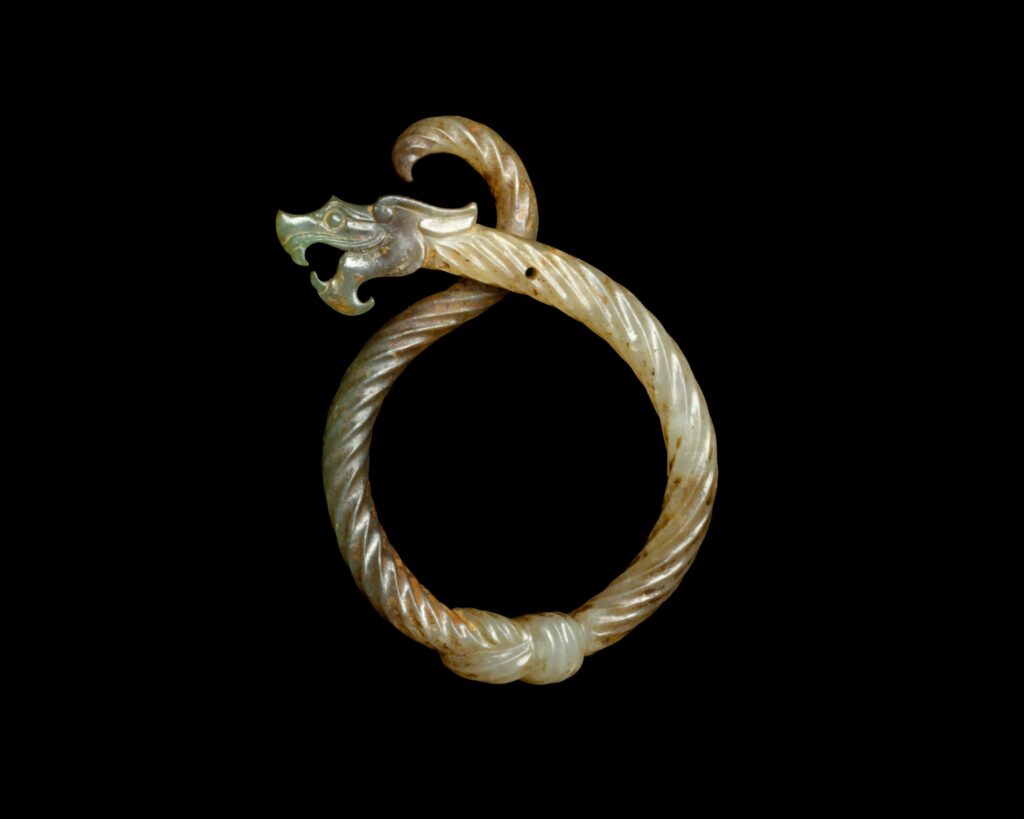
Knotted dragon ring, China, Eastern Zhou dynasty, 3rd century BCE. Nephrite jade carved into a sinuous, grooved body resembling twisted rope. The Metropolitan Museum of Art.
Across the Pacific, Mesoamerican craftspeople developed an equally sophisticated tradition using jadeite. Much of their stone came from the Motagua Valley of present-day Guatemala. For the Olmec and Maya, green stone carried associations with water, maize, breath and life, and was made into beads, pendants, masks and other objects of extraordinary refinement.
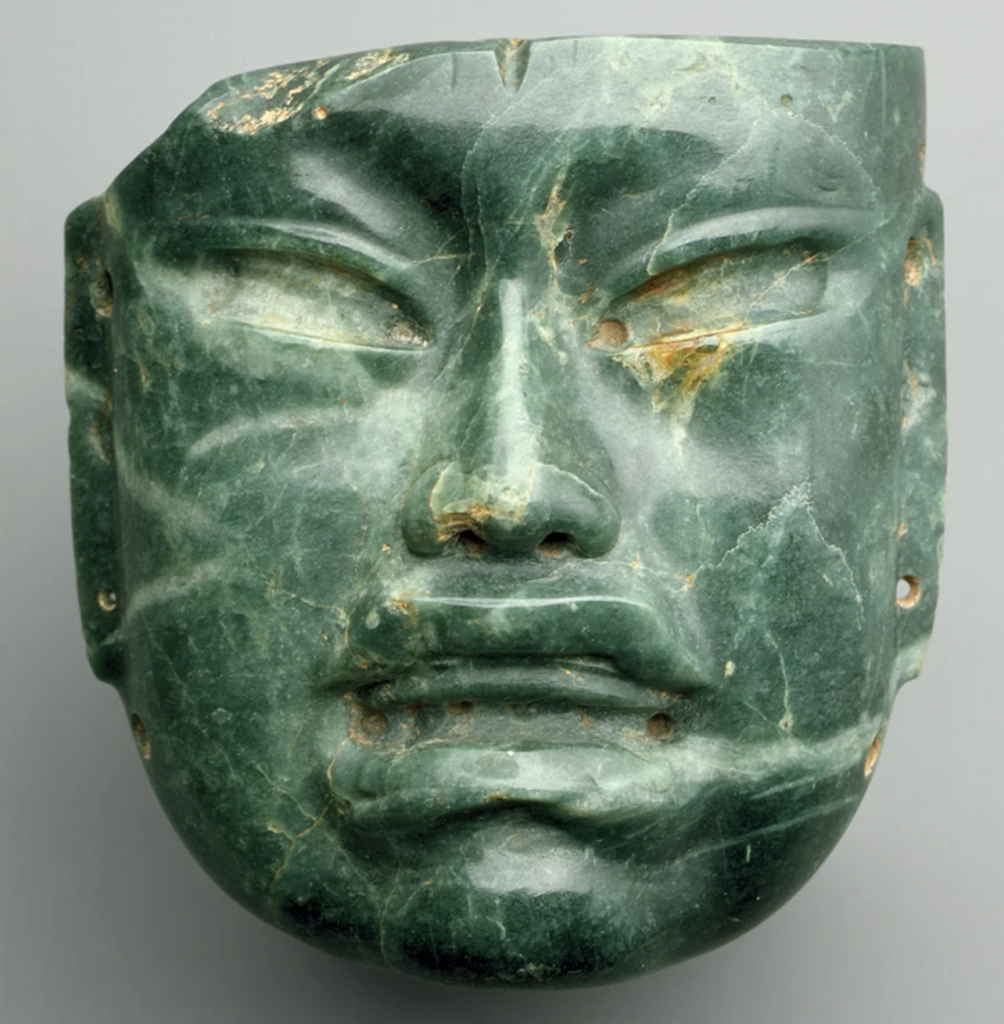
Olmec face carved from jadeite, Mexico, 900–400 BCE. The stone likely originated in the Motagua River Valley of present-day Guatemala, the principal source of jadeite in ancient Mesoamerica. The Metropolitan Museum of Art.
The two traditions had different stones, different meanings and no known connection. Yet their makers arrived at remarkably similar techniques.
Both jade traditions relied on sawing, drilling, grinding and polishing. Cords and tubular drills used with abrasive material could slowly cut through stone, while repeated grinding produced smooth surfaces and increasingly precise forms.
The resemblance is a useful reminder that similar craft does not always mean shared origin. Sometimes people in different parts of the world encountered the same material problem and discovered similar ways to solve it.
Carnelian: From the Indus to Gujarat and Across the Indian Ocean
For thousands of years, western India has been one of the world’s great centres of carnelian bead making. During the Indus Valley Civilization, craftspeople produced long, highly polished beads that travelled as far as Mesopotamia. Drilling through the hard stone required specialized stone drills, including a material archaeologists call Ernestite.
Centuries later, South Asian bead makers developed a new solution: the diamond-tipped drill. By around the sixth century BC, double-diamond drilling was being used in Gujarat. Two small pieces of diamond were fixed to the end of a metal drill, allowing the rotating tool to cut a wider, cylindrical hole through hard stones such as carnelian and agate. The technique became particularly associated with the stone-working traditions of western India and is still practised in Khambhat today.
These rich red beads, warm to the touch and impossibly smooth, made their way across the sea. By the first millennium CE, identical carnelian beads—carved with the same Indian diamond-tip drill technology—begin to appear across the Indian Ocean, in burial sites along the East African coast, in places like Kenya and Tanzania. (ref 1)
A bead can therefore preserve two different journeys: the movement of the stone itself and the movement of the knowledge used to shape it.

Carnelian beads excavated at Banganarti, Sudan, with their raw material traced to sources in Iran, India, Yemen and Egypt, evidence of the long-distance networks through which carnelian moved across South Asia, Arabia and Northeast Africa. Kenoyer et al., 2025.
Intaglio: Carving an Image Into Stone
Elsewhere, stone carving became extraordinarily small.
The tradition of engraving stones as seals reaches back thousands of years in the ancient Near East. Cylinder seals were carved with recessed images and rolled across wet clay, transforming a tiny stone into a repeating scene.
Greek and Roman lapidaries pushed gemstone engraving to remarkable levels of detail. In an intaglio, the image is carved below the surface so that pressing the stone into wax or clay produces a raised impression.
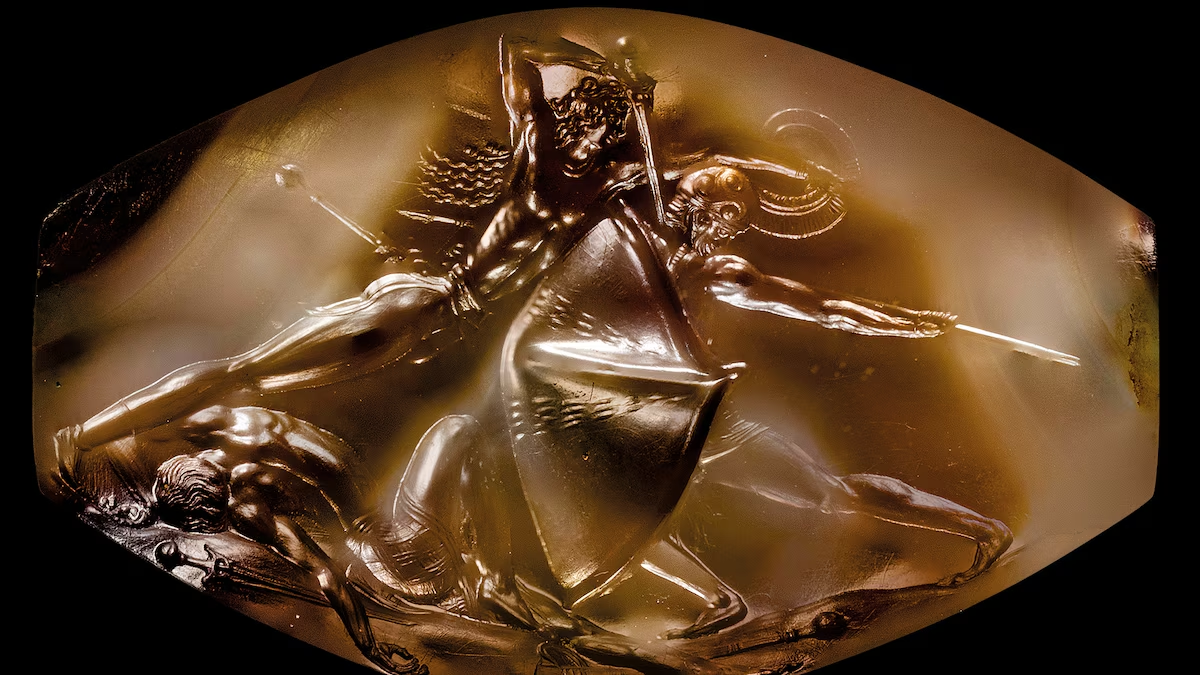
The Pylos Combat Agate, c. 1450 BCE, discovered in the tomb of the Griffin Warrior at Pylos, Greece. Measuring just 3.6 centimeters, the agate sealstone depicts three warriors in remarkably detailed combat and was likely carved by a Minoan artisan.
Faces, animals, inscriptions and entire mythological scenes could be cut into stones small enough to wear on a finger.
The object was both image and tool. A carved gemstone could identify its owner, authenticate a document or close a container, while also functioning as jewelry.
The tradition travelled widely through the ancient Mediterranean and Near East and survived long after the civilizations that first developed it. Intaglios were collected, copied, reset into later jewelry and revived repeatedly, particularly during the Renaissance and again in the eighteenth and nineteenth centuries.
Gandhara: When a Visual Language Travels
Another lineage of technique moved by land. In the Gandharan region of northwest India and present-day Pakistan, Buddhist artisans began carving stone figures with features unmistakably Greek: swirling robes, muscular bodies, wavy hair. This was not a coincidence. After the campaigns of Alexander the Great, Greco-Roman sculptural traditions entered the region—and local carvers responded.
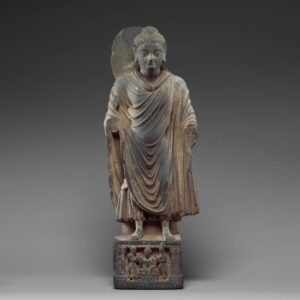
Standing Buddha, Gandhara, present-day Pakistan, c. 3rd–4th century CE. Carved from schist, a stone widely used by Gandharan sculptors. The Metropolitan Museum of Art.
These forms emerged after centuries of interaction between South Asia, Central Asia and the Mediterranean following Alexander’s campaigns and the kingdoms that succeeded them. Cultural contact gave birth to a distinct style distinct style of devotional images that carried both local belief and foreign technique. It’s one of the clearest historical examples of aesthetic transmission through skill, not conquest.
These moments when a style shifts and when a method reappears thousands of miles away tell us something critical: that skill, technology, and ways of seeing migrate, not just materials.
Pietra Dura: Florence and Agra
By the sixteenth century, stoneworkers in Florence were using coloured stone in another way entirely.
Rather than carving an image from a single block, commesso di pietre dure created images from many pieces of stone cut to fit precisely together. Under the Medici, specialist workshops transformed jasper, agate, chalcedony and other stones into flowers, birds, landscapes and elaborate patterns.
The technique depended on understanding the stone before cutting it. A vein could become the fold of a leaf. A patch of colour could become a petal. The natural variation of the material became part of the image.
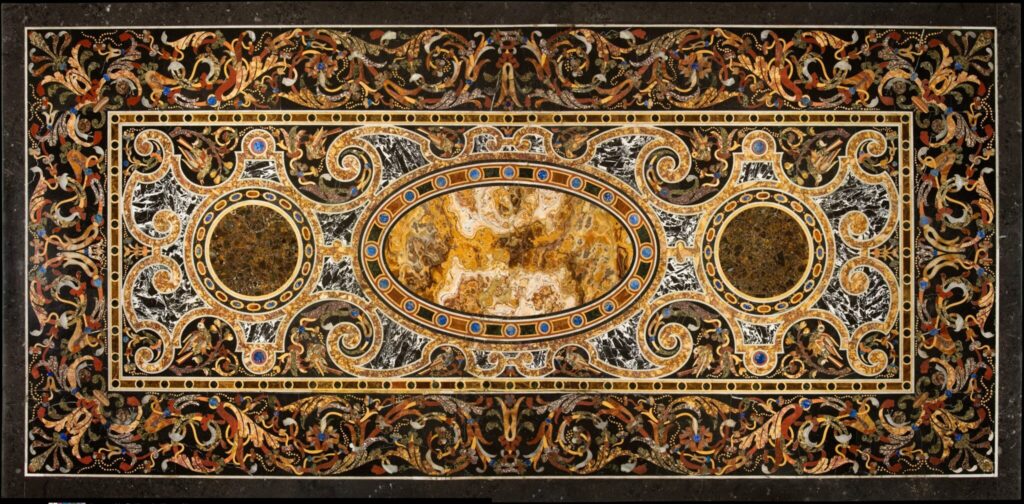
Pietra dura tabletop, Rome, late 16th or early 17th century. Hardstones, alabaster and marble are cut and fitted into an elaborate composition of geometric forms, animals and floral motifs. The Metropolitan Museum of Art.
Florentine stonework soon circulated beyond Italy.
Around the same period, the Mughal court in India was developing increasingly elaborate stone inlay. Known as parchin kari, the technique reached its most famous expression in the Taj Mahal, built in the seventeenth century.
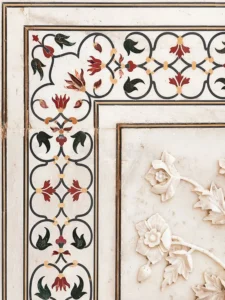
Parchin kari at the Taj Mahal, Agra, India, 17th century. Precisely cut colored stones are inlaid into white marble to form intricate floral designs.
There, white Makrana marble is inset with carnelian, jasper, lapis, jade and other coloured stones. Flowers and vines appear to grow across the architecture, yet the surface remains smooth. Each fragment has been cut to fit into a corresponding recess in the marble.
Exactly how the relationship between Florentine and Mughal stone inlay developed remains debated. European objects and craftspeople reached the Mughal court, but India already possessed sophisticated traditions of stone cutting and inlay. What emerged under the Mughals was not simply Italian pietra dura reproduced in India.
This is where cultural transmission becomes difficult to reduce to a single origin. An imported object can introduce an idea without introducing the hand that made it. An existing craft can absorb a foreign technique without abandoning its own knowledge. The result can eventually become a tradition in its own right.
Parchin kari is still practised in Agra today.
At the Bench
At Iaia, we encounter these histories through the carved stones made for us in Jaipur. Stone carving reveals a world without shortcuts. Refinement doesn’t come from the rarity of the material. It comes from the time spent in its presence. From the rhythm of tools against grain, and from shared hands across generations.
Each carved bead or pendant in our collections is a continuation of a universal lineage of bringing form out of resistance, of knowing how to listen to the material, and of carrying forward something that was never written down, only practiced.
Each stone moves through several stages of shaping, grinding and polishing before reaching its finished form. A single Snakefruit seed takes approximately several hours to carve from rough stone.
Carving makes the material precious—not the other way around.
Too often, we think of materials and techniques as static and bound to a singular place. But nothing could be further from the truth. Stone, by its nature, resists change, yet carved stone proves otherwise. It carries human intervention. When that intervention is skilled, shared, and sustained across centuries, it becomes something greater than ornament.
It becomes a language.