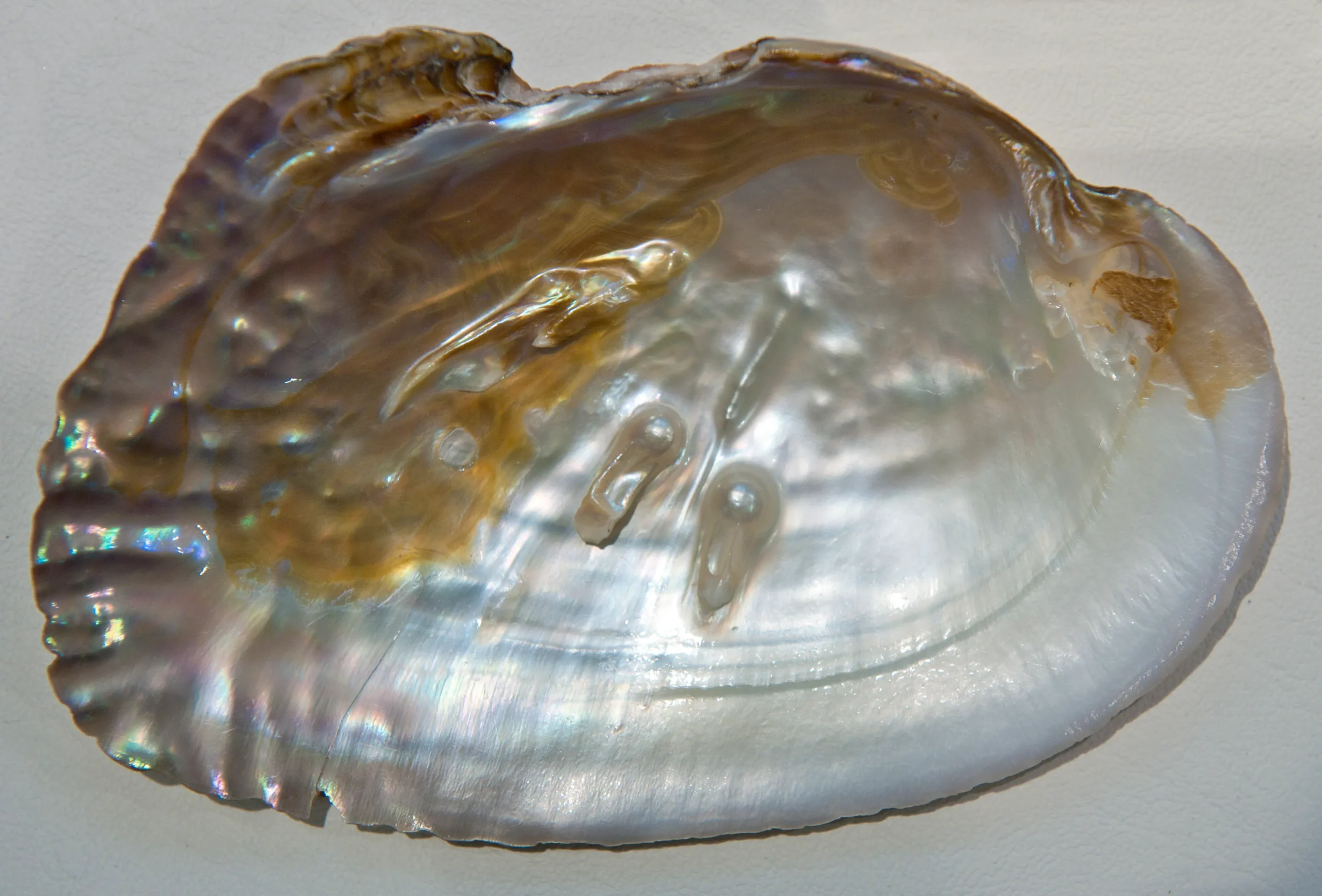
Across tens of thousands of years, communities separated by oceans found uses for it independently, while trade carried particular shells and techniques far beyond their original waters.
First Evidence: Pearl Shell in Australia
Some of the earliest evidence comes from Western Australia. A piece of pearl shell found at Widgingarri in the Kimberley is about 22,000 years old. Before it was left in the rockshelter, it had already travelled roughly 200 kilometres inland from the coastline of the time. Evidence from the wider region suggests shells were moving across even greater distances as far back as 32,000 years ago.
Along the Kimberley coast, Aboriginal makers developed a distinctive tradition using the large shell of Pinctada maxima. Engraved pearl shells, known by names including riji and jakuli, were ground to expose their iridescent surface, then incised with geometric patterns. The grooves could be filled with ochre, charcoal, resin or fat.
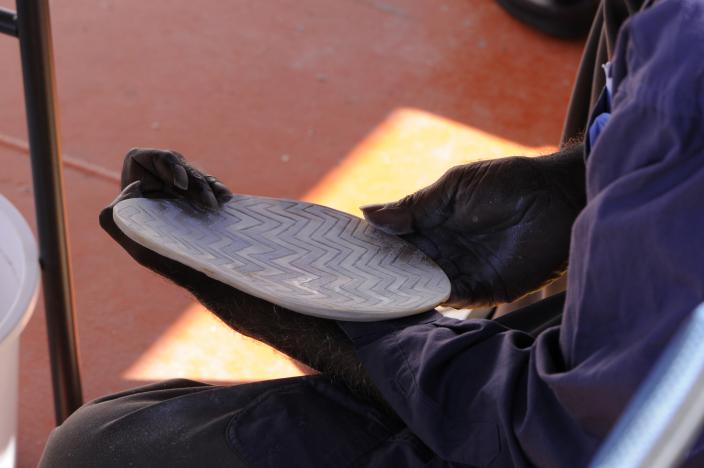
Working guwan, or undecorated pearlshell, in Western Australia’s Kimberley region. Once shaped and incised with ramu, the shell becomes riji, a ceremonial object that has travelled through Aboriginal exchange networks across Australia.
The shell was associated with water, rain and lightning, and used in ceremony, initiation, healing and rainmaking. It also travelled astonishing distances. Through Aboriginal exchange networks, Kimberley pearl shell moved more than a thousand miles into the Australian interior and as far as the continent’s southern coast.
In desert country, an object born in the sea carried the presence of water with it. The tradition continues today, with Kimberley makers still collecting, shaping and engraving pearl shell.
Mother of Pearl in Mesopotamia
Thousands of years later, mother of pearl appears in the cities of ancient Mesopotamia.
A small piece of marine shell found at Tepe Farukhabad in present-day Iran had travelled inland from the Persian Gulf before being cut, polished and engraved sometime in the fourth millennium BC.
By around 2500 BC, shell appeared in some of Mesopotamia’s most extraordinary objects. The Standard of Ur was covered in mosaics of shell, red limestone and blue lapis lazuli. The famous lyres excavated from the same Royal Cemetery also used shell, cut into figures and set against dark bitumen.
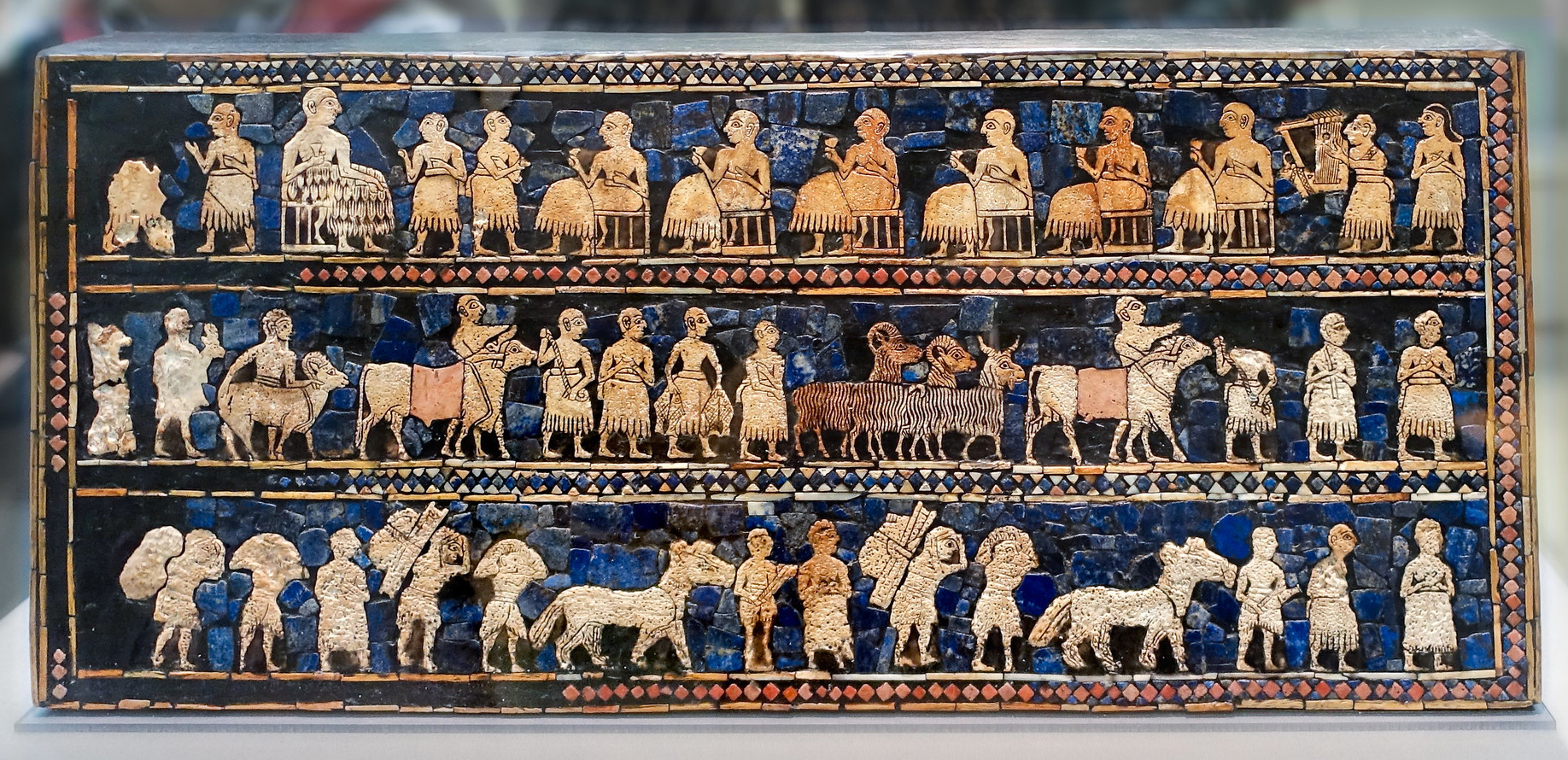
The “Peace” side of the Standard of Ur, c. 2600–2400 BCE, from the Royal Cemetery at Ur in present-day Iraq. The mosaic is made from shell, red limestone and lapis lazuli set into bitumen, bringing together materials that reached Mesopotamia through long-distance trade. British Museum.
Here mother of pearl had become part of a sophisticated language of inlay: a pale, reflective material whose contrast against dark surfaces made images appear almost illuminated.
From Gujarat to the Mediterranean
By the sixteenth century, artisans in Gujarat, on India’s western coast, had become renowned for covering vessels, boxes and furniture with precisely cut pieces of mother of pearl.
Their work circulated through the Mughal world and travelled outward through Portuguese trading networks. Some pieces were made specifically for European buyers. Gujarati mother of pearl plates, ewers and caskets eventually entered royal collections in Lisbon, Dresden, Paris and London.
These objects are difficult to assign to one cultural world. Their forms could respond to European tastes, their craftsmanship was Indian, and their shell came through the waters and markets of the Indian Ocean.
Mother of pearl inlay was also well established farther west, particularly in the eastern Mediterranean and the Levant, where shell was worked into wood alongside bone and ivory. In Bethlehem, however, the material developed a particularly enduring relationship with pilgrimage.
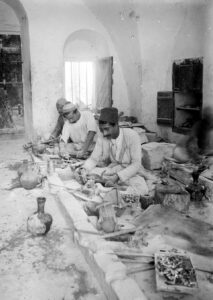
Artisans working mother-of-pearl in a workshop in Bethlehem.
From at least the early modern period, local artisans carved mother of pearl alongside olive wood into rosaries, crucifixes and models of sacred sites. Pilgrims bought these objects and carried them home, creating another kind of trade network through the movement of people themselves.
The craft became part of Bethlehem’s economy and provided work for women as well as men. It survives today, although only a small number of artisans in the Bethlehem area retain a high level of skill in traditional mother of pearl carving.
China, Korea and Japan
Across East Asia, mother of pearl found another partner: lacquer.
Shell had been incorporated into Chinese decorative arts for centuries before techniques of mother of pearl lacquerwork travelled and developed throughout the region.
In Korea, the tradition became known as najeonchilgi. Makers cut mother of pearl into extraordinarily fine pieces and embedded them into dark lacquer, using the natural shifts of colour within the shell as part of the design.
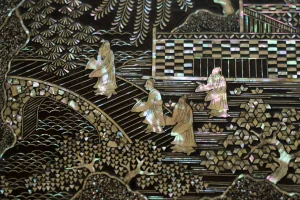
Raden mother-of-pearl inlay depicting figures in a landscape, Japan.
In Japan, the related technique is called raden. It developed through exchange with Tang China and appears in objects preserved in the eighth-century Shōsōin repository in Nara. Japanese makers eventually developed their own approaches using abalone, pearl oyster, turban shell and other shells, choosing between them for their different colours and iridescence.
Across the Pacific to Mexico
Beginning in the late sixteenth century, the Manila Galleons sailed between Manila and Acapulco, creating a direct commercial route between Asia and the Americas. Among the goods crossing the Pacific were Japanese lacquer objects decorated with mother of pearl.
In seventeenth-century Mexico City, a remarkable form of painting called enconchado emerged. Artists embedded fragments of mother of pearl directly into paintings, allowing the shell to catch the light through clothing, architecture, clouds and halos.
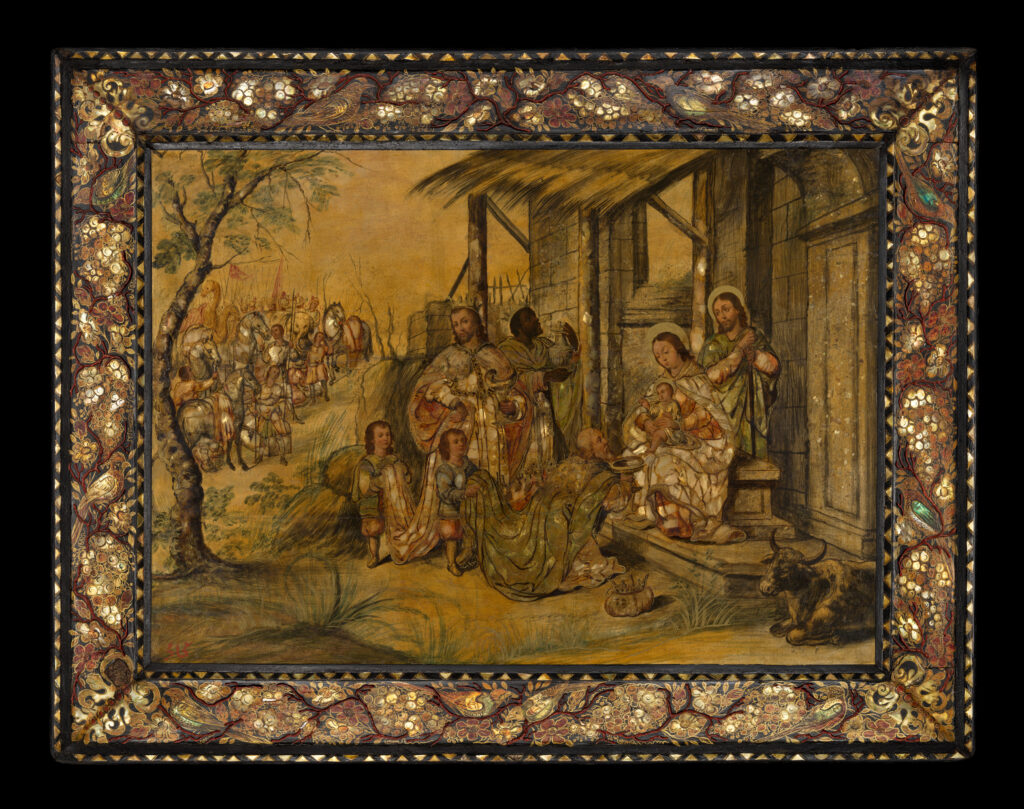
The Adoration of the Magi, attributed to Miguel González, Mexico, c. 1695–1700. Oil on wood inlaid with mother-of-pearl and gold, using the Mexican enconchado technique. The Metropolitan Museum of Art.
The influence of Asian objects is particularly visible in the black-and-gold frames surrounding many of these paintings, which bear a strong resemblance to Japanese lacquer made for export.
Yet enconchado was not simply a Japanese technique transplanted to Mexico. It developed in New Spain, where Asian imports encountered European painting and an older Indigenous tradition of working with shell. The result belonged specifically to this point of cultural convergence.
Some of these paintings then travelled onward to Spain. In the space of a century, mother of pearl and the techniques surrounding it had crossed the Pacific from Asia to Mexico, been transformed there, and crossed the Atlantic again.
From Sacred Material to Industrial Commodity
By the nineteenth century, the history of mother of pearl changed dramatically. Industrial manufacturers in Europe and America wanted enormous quantities of shell for buttons, buckles, cutlery handles, watch faces and furniture inlay.
One of their most important sources was Western Australia, returning us to where this story began thousands of years earlier.
The shell being harvested there was Pinctada maxima, the same large pearl oyster used by Aboriginal makers in the Kimberley. A material that had been engraved and exchanged across the Australian continent for thousands of years was now being extracted on an industrial scale for a global consumer market.
Supplying that demand came at enormous human cost. Aboriginal people were coerced into the early colonial pearling industry, first gathering shell in shallow water and later diving for it. As the industry expanded into deeper waters, Japanese, Malay, Timorese and other Asian divers and crew were brought to the northwest coast to work in exceptionally dangerous conditions.
Broome became one of the world’s great centres of pearl-shell production and, as a consequence, one of Australia’s most culturally diverse towns. Japanese, Chinese, Malay, Filipino, Timorese, Sri Lankan, European and Aboriginal communities lived alongside one another there, drawn together in large part by global demand for the luminous inner surface of a shell. The pearl itself was often secondary.
For much of the nineteenth and early twentieth centuries, the real commodity was mother of pearl.
✦
Today, mother of pearl continues to move between the ordinary and the precious. It appears on watch dials and shirt buttons, in musical instruments and jewelry. In Bethlehem it is still carved by hand. Korean artisans continue najeonchilgi, Japanese makers practise raden, and in the Kimberley, pearl shell is still collected, engraved and exchanged.
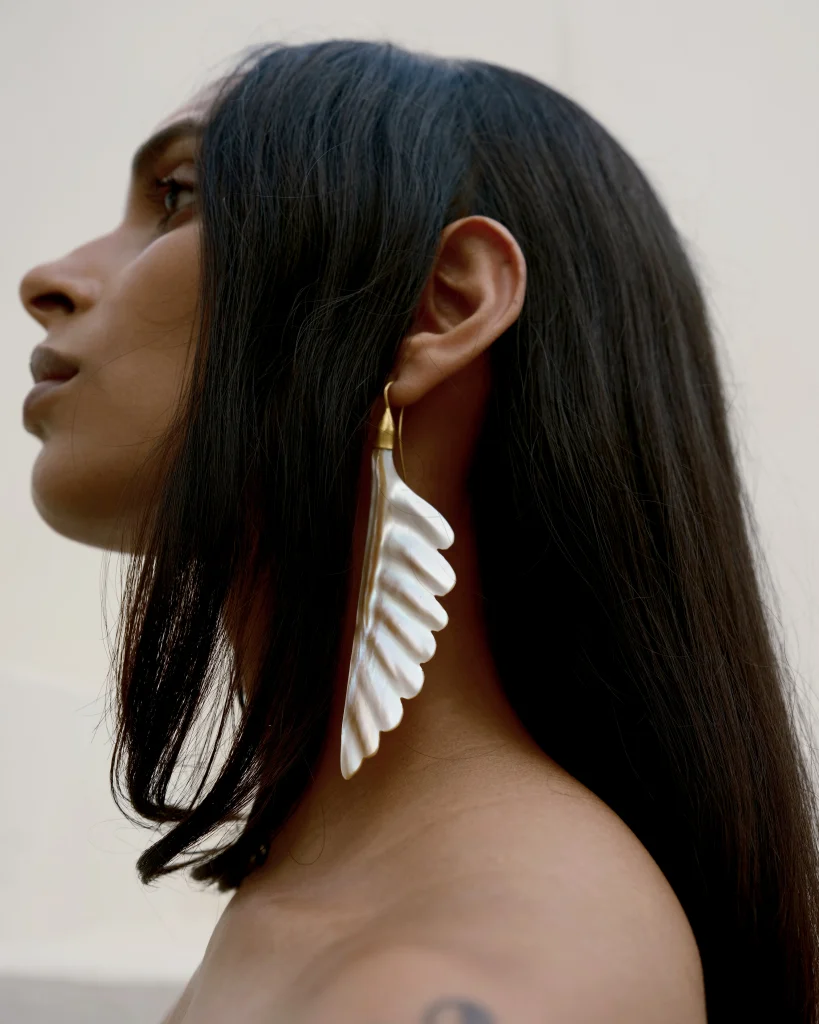
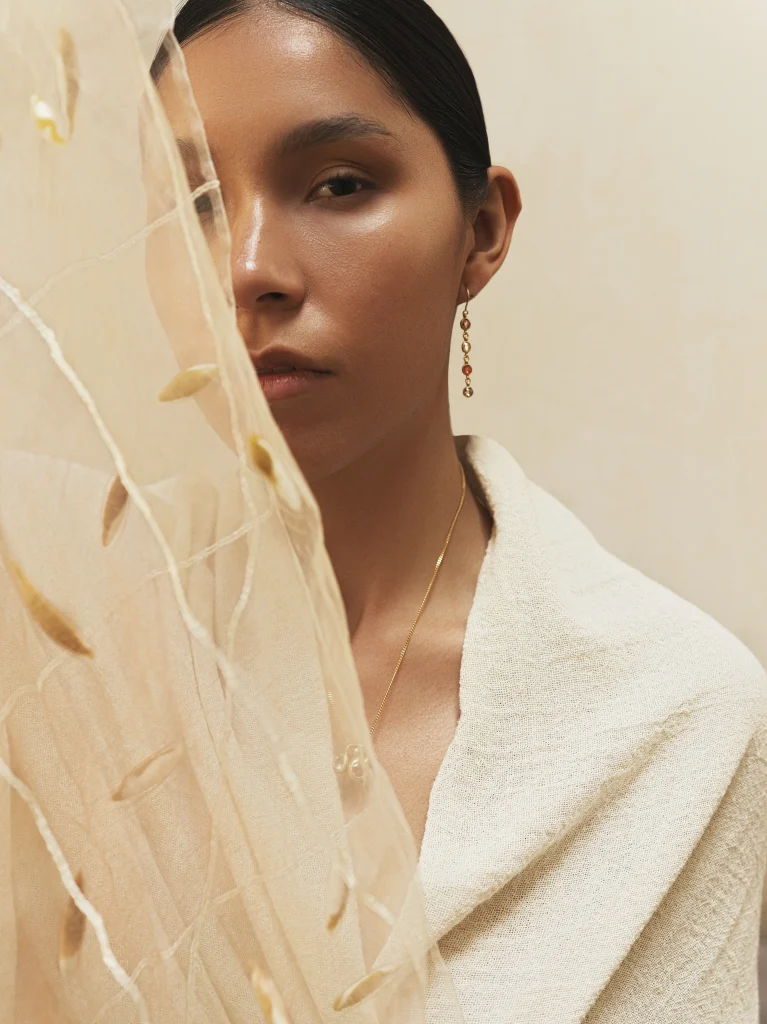
At Iaia, we encountered mother of pearl in Jaipur, where Om ji and his team carve mother of pearl into the wings used in our Trade Winds earrings. Each piece begins as a section of shell and is shaped individually at the wheel, a process that takes approximately two days.