Blue is one of the rarest colors found in nature. From the pharaohs of ancient Egypt to the painters of Renaissance Europe, lapis was prized wherever it arrived. Lapis lazuli carried the color of the sky across continents, appearing in tombs, temples, jewelry, manuscripts, and paintings thousands of miles from the place it was mined. Its rarity made it extraordinarily valuable, at times worth more than its weight in gold.
The color gave the stone an association with the heavens that followed it across cultures. Lapis came to signify divinity, wisdom, truth, and understanding, meanings that still resonate today.
The Mines of Badakhshan
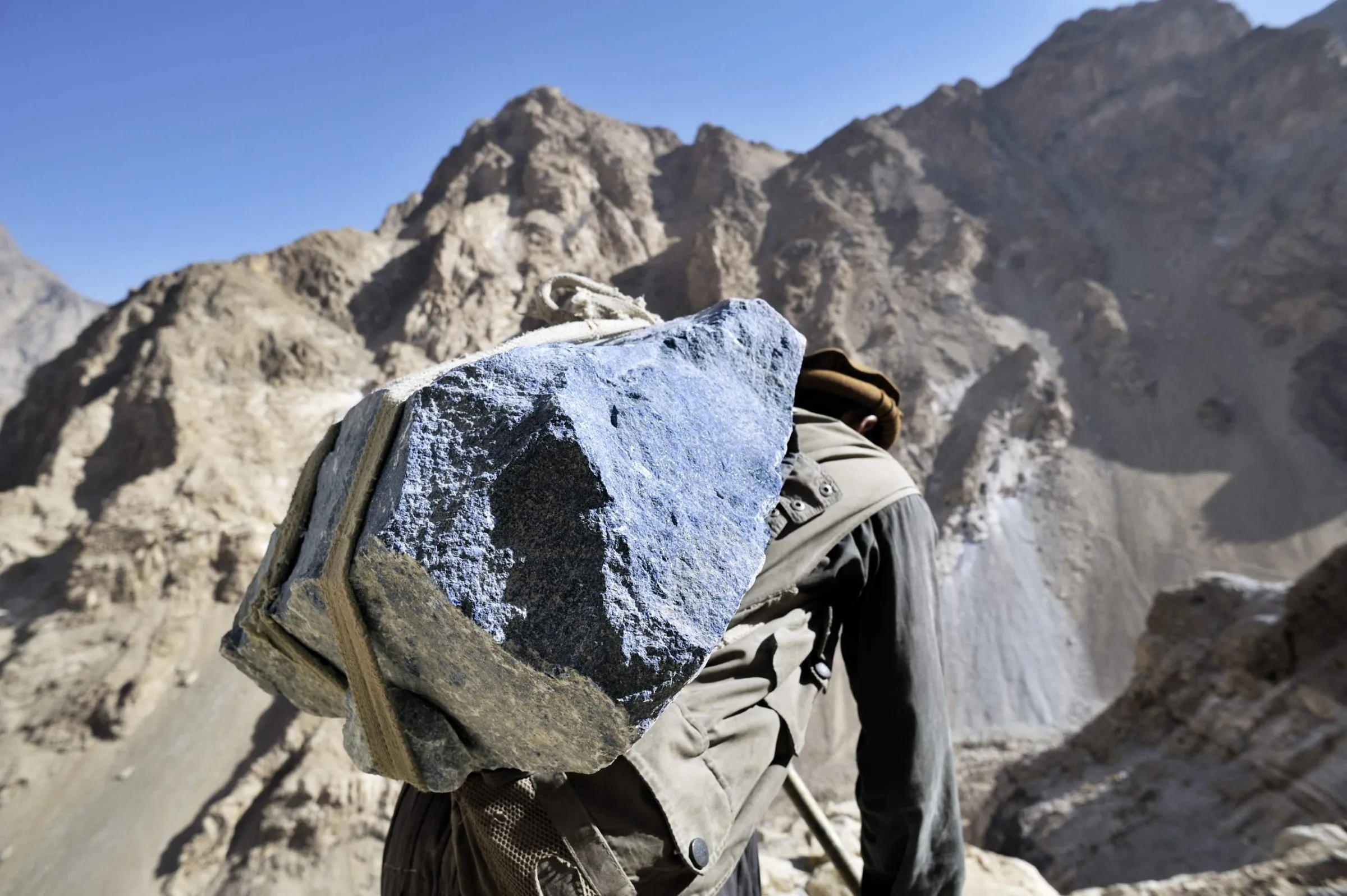
The most important lapis deposits lie at Sar-i Sang, high in the Hindu Kush. The ancient mines sit hundreds of meters above the Kokcha Valley, reached only by steep mountain paths. For over 9,000 years, miners have climbed these slopes in search of lapis, carrying tools, fuel, and water with them. For much of that history they used a method known as fire-setting: large fires were built against the rock face, heating and weakening it so the stone could be worked with picks, hammers, and chisels. Over generations the method opened enormous chambers inside the mountain, their walls blackened with soot. Eventually explosives replaced fire-setting, but mining at Sar-i Sang continued, making Badakhshan one of the longest-worked mining regions in the world. To this day, Afghanistan remains home to the world’s largest deposit of lapis lazuli.
The First Lapis Routes
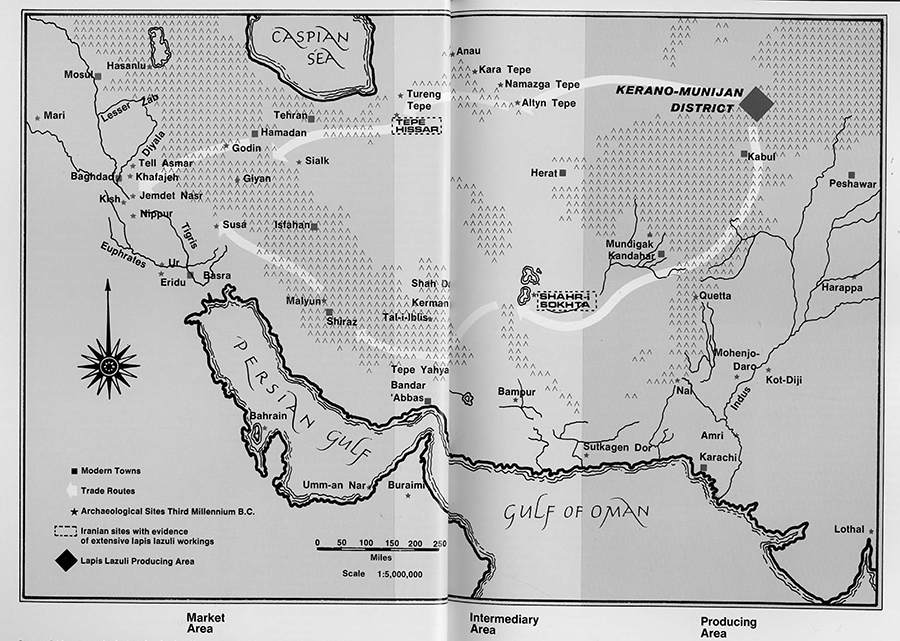
Once extracted, the stone began to travel. As early as 7,570 BCE, lapis lazuli from Afghanistan had reached Bhirrana, one of the oldest sites of the Indus Valley civilization. By the Bronze Age, it was moving through networks that stretched west across Afghanistan and the Iranian plateau toward Mesopotamia, and east toward China. These exchanges were taking place thousands of years before the routes we now call the Silk Roads took shape.
Lapis often left Badakhshan as rough stone, to be cut and finished at different points along its journey. One of the clearest examples is Shahr-i Sokhta in present-day eastern Iran, where lapis was worked between roughly 3200 and 2300 BCE. Archaeologists have found large quantities of semi-processed stone, flakes, unfinished and broken beads, and other working debris, but comparatively few finished lapis objects. The evidence suggests that Shahr-i Sokhta was a major processing centre: rough stone arrived from Badakhshan, was cut and shaped there, then continued onward. Evidence from other sites suggests that this was not unique to Shahr-i Sokhta. The route out of Badakhshan was also a chain of workshops, each carrying the stone one stage closer to its finished form.
From Ur to Egypt
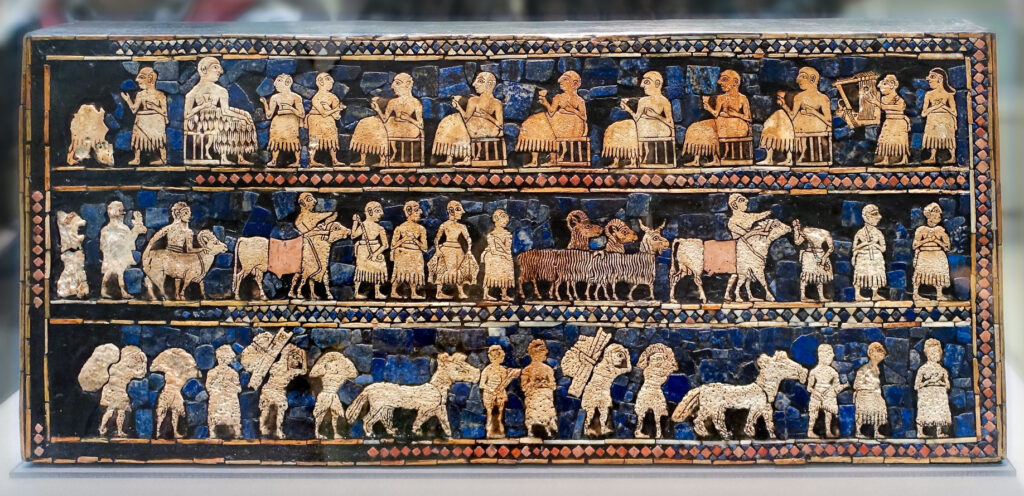
By around 2600 BCE, lapis had reached the Royal Cemetery at Ur in Mesopotamia, more than 2,000 kilometres from Badakhshan. It appears in some of the most elaborate objects of the Sumerian court. The Standard of Ur sets intensely blue lapis beside shell and red limestone, while the celebrated lyres from the cemetery combine lapis, shell, gold and other precious materials.
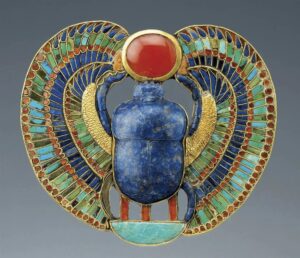
Lapis also reached Egypt, which had no known source of its own. The stone traveled from the mines of Badakhshan across an extraordinary distance before being carved in Egypt into beads, amulets, and scarabs and worked into jewelry alongside gold, turquoise and carnelian. Its rarity, brilliant color, and imported origin made lapis a particularly prized material. Lapis also appeared among the jewelry and funerary objects buried with Tutankhamun, alongside Egyptian-made blue materials such as faience and coloured glass.
From Lājvard to Ultramarine

Lapis’ movement can even be followed through language. Persian lājvard, a word for both the stone and its blue, passed through Arabic and into European languages, giving us words including lazuli, azure and azul. In Persian poetry, Sanai of Ghazni described the night sky as a kārgāh-e lājvard, a workshop of lapis. In Europe, pigment made by grinding and processing the stone became known as ultramarine, from the Latin ultramarinus, “beyond the sea.” By the Renaissance, it was among the most expensive pigments available, famously used for the robes of the Virgin Mary. Only with the invention of synthetic ultramarine in the nineteenth century could the color finally be produced without lapis making the long journey from Central Asia.
The Geography of Lapis Today
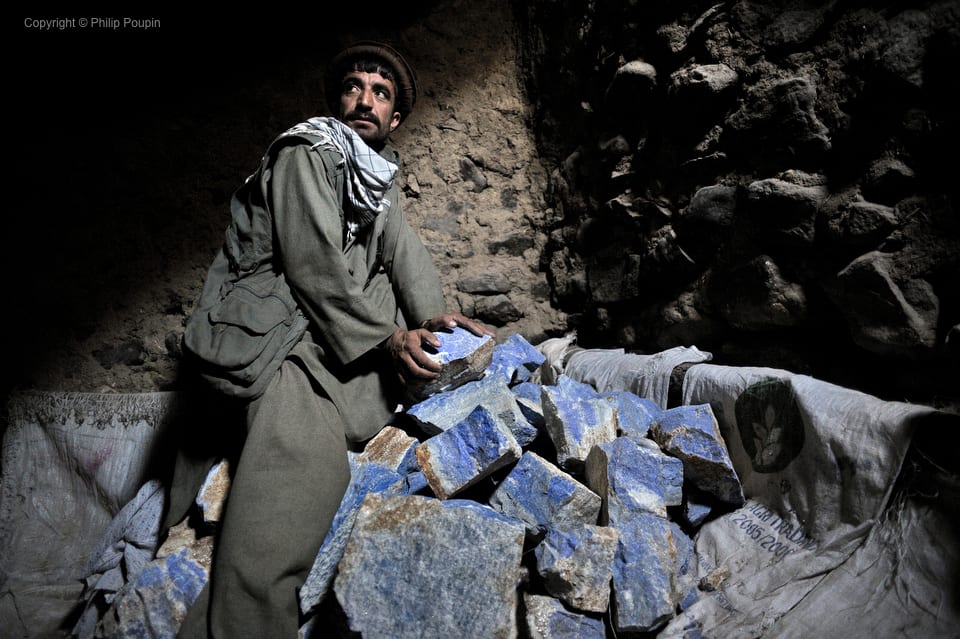
Whoever holds Badakhshan holds the lapis. For decades, control of the mines and the roads surrounding them has shifted with Afghanistan’s politics.
During the war that preceded the Taliban’s return to power, revenue from the lapis mines became entangled with local strongmen, armed groups, and the Taliban. In 2016, Global Witness documented how competition over the mines and the roads leading from them had helped finance armed groups and destabilize the region.
Since the Taliban returned to power in 2021, they have brought Afghanistan’s mineral sector under their administration. Mining has become an increasingly important source of government revenue, but determining who ultimately benefits from it remains difficult to establish. The industry supports livelihood across Afghanistan, particularly in remote regions where other work is scarce. In Badakhshan, entire communities depend on the extraction, transport, trade, cutting, and sale of the minerals beneath their mountains.
Lapis has been one of Afghanistan’s oldest connections to the world beyond it, carried across thousands of kilometers for millennia. And it remains today mined by hand, in the same valley, under whoever happens to be in charge.
✦
For our collaboration with ISHKAR, we turned to the source–the Kokcha Valley and the mountains and ravines surrounding it–for inspiration.
We traced mountain ranges, studied contour lines, topographical maps, and strata, and looked closely at the shapes & structures of the landscape. Geological layers became stacked and stepped forms, strata became mosaics, ridges became edges. Lapis appears throughout.
Our collaborators at ISHKAR have spent years working with Afghan artisans and building relationships with communities affected by conflict. This collaboration brings that experience and those relationships together with Iaia’s design practice.